Extensions and OIP
Two layers of contract
ANCHOR draws a deliberate line:
-
ANCHOR-level extensions are Python packages that share ANCHOR's process, register node types, edge styles, and MCP tools, and can reach into canvas internals when they have to. They follow the contract in
EXTENSIONS.md. The bundled producers ship in-tree today; third-party extension loading remains proposed. -
OIP producers are anything that ingests source material into a region-of-interest layout that any consumer (ANCHOR, but also others) can attach to. They speak a vendor-neutral on-disk shape and an MCP-stdio invocation contract. They don't import ANCHOR; ANCHOR doesn't import them. Discovery happens through a manifest file at a known path.
Every ANCHOR extension is an OIP producer (it ships a manifest and writes OIP-shaped artefacts). Not every OIP producer is an ANCHOR extension. That's the whole point.
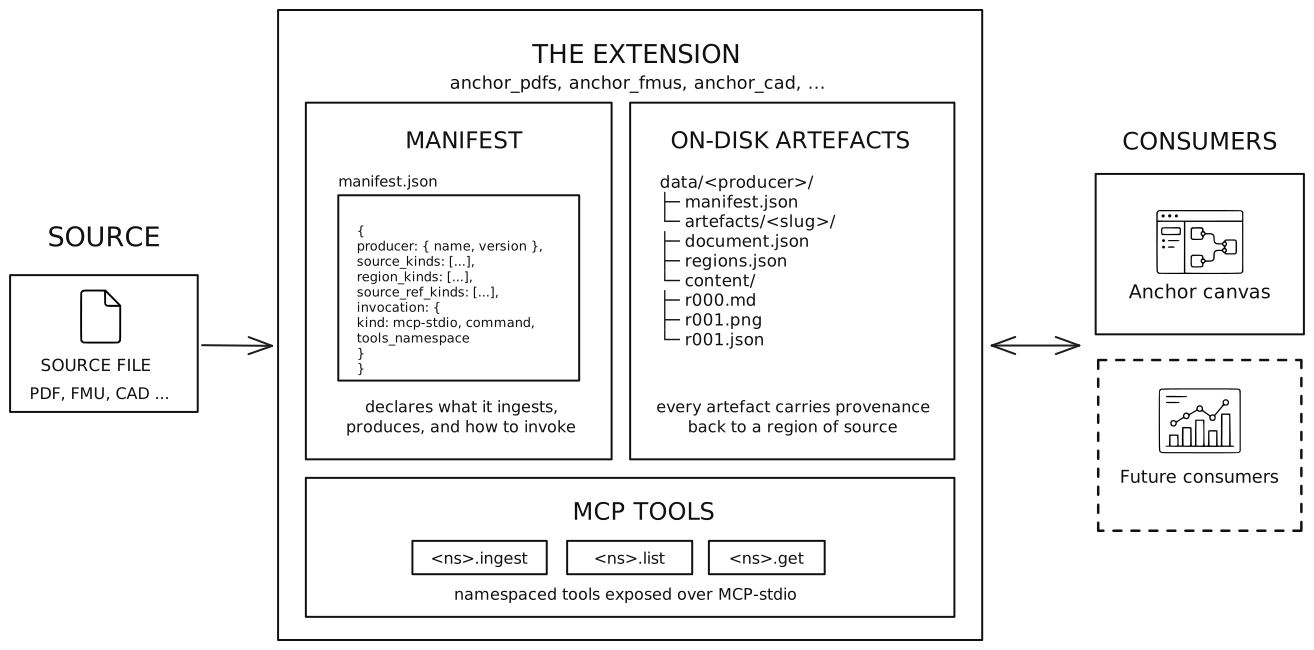
An OIP producer is three things: a manifest, an on-disk artefact shape, and a set of MCP tools. ANCHOR extensions add canvas-side hooks (node types, edge handlers, React components) on top of that — but those hooks are advisory. Another OIP consumer can render the same artefacts differently.
The OIP manifest
A producer drops a single JSON file at a discoverable path. The file
declares what the producer ingests, what it produces, and how a
consumer invokes it. Verbatim from anchor_fmus:
{
  "oip_version": "0.1",
  "producer": {
    "name": "anchor-fmus",
    "display_name": "ANCHOR FMUs",
    "version": "0.2.3",
    "homepage": "https://github.com/Novia-RDI-Seafaring/anchor"
  },
  "kind": "bundled-in-tree",
  "data_dir": "/.../data",
  "produces": {
    "source_kinds": ["application/x-fmu"],
    "region_kinds": ["fmu_variable", "fmu_parameter",
                     "simulation_result", "plot"],
    "source_ref_kinds": ["fmu-variable", "fmu-simulation-time"]
  },
  "invocation": {
    "kind": "mcp-stdio",
    "command": "anchor-mcp",
    "args": [],
    "tools_namespace": "fmu"
  },
  "ui_hints": {
    "node_types": [
      {"name": "fmu:model", "renders": "card with input/output handles + parameters"},
      {"name": "fmu:variable", "renders": "single-variable badge with current value"},
      {"name": "fmu:plot", "renders": "Recharts line plot of selected variables"}
    ],
    "edge_styles": {"fmu:wires": {"stroke": "#0EA5E9", "dasharray": "0"}},
    "source_ref_handlers": {
      "fmu-variable": "open the FMU model node, highlight that variable",
      "fmu-simulation-time": "open the plot node, scrub to that time"
    }
  }
}
Three fields do most of the work:
source_kinds— what MIME types this producer accepts. A consumer routes a dropped file to the producer that claims its kind.region_kinds— the names of the structured regions the producer emits. A consumer renders them differently per kind.source_ref_kinds— the polymorphic "where did this come from" keys.pdf-page-bboxcarries page + bounding box;audio-timestampcarries seconds;fmu-variablecarries a variable name. Consumers route these to UI behaviours.
ui_hints is advisory. A consumer may render exactly what the
producer suggests, or substitute its own components. The producer
isn't shipping React; it's shipping intent.
Page source-reference coordinates
Current page/bbox authoring uses PDF points, top-left origin,
[left, top, right, bottom]. Writers explicitly emit
coord_origin: "top-left". HTTP, MCP and CLI share the same authoring
contract for node, row, edge and bibliography references. Geometry supplied
as a new write without an origin uses that current contract; explicitly
declared origins are preserved. Copying existing geometry must preserve
its origin too. Use coord_origin: null when importing geometry whose
origin has not been established. Loading or replaying stored data never
assigns an origin based on its absence.
Startup source-reference migration converts only an explicit
coord_origin: "bottom-left" with usable page dimensions. An unstamped
reference is ambiguous, even when its document is canonical or was just
migrated. Such references are preserved and reported. Stamped top-left
references are preserved too; the stamp does not prove that an older
migration did not corrupt them. Repair requires separate authoritative
provenance, not another blanket flip. Non-page producer locators retain
their own conventions.
On-disk shape
A producer that has ingested anything writes:
data/
├── manifest.json                    ← matches the produced manifest
└── artefacts/
    └── <slug>/                      ← one folder per ingested document
        ├── document.json            ← title, source_kind, ingested_at, source_path?, size_units
        ├── regions.json             ← list of regions, each with id, kind,
        │                              source_ref, content paths
        └── content/                 ← payload — markdown, JSON, PNG, ...
            ├── <region-id>.md
            ├── <region-id>.png
            └── <region-id>.json
Every region has an id (<slug>:r0042), a kind (one of the
producer's declared region_kinds), a source_ref (one of the
producer's declared source_ref_kinds), and content.{text|image|json}
paths relative to artefacts/<slug>/.
The slug is deterministic — re-ingesting the same input gives the same slug, so artefacts are content-addressable.
What's in the in-tree extensions today
anchor_pdfs — the PDF medallion
| Stage | What it does | Tool |
|---|---|---|
| bronze | store raw PDF bytes | ingest_pdf |
| silver | Docling extraction → page index, items, bboxes | get_document_index |
| gold | OpenAI vision polish + region extraction | get_gold_regions |
MCP tools include ingest_pdf, list_documents, get_document_index,
get_gold_regions and get_page_text. Two node
types declared (pdf:document, pdf:spec_table). One source-ref kind
(pdf-page-bbox).
anchor_fmus — FMU inspector + simulator
| Action | Tool |
|---|---|
| inspect a fresh FMU | fmu_inspect |
| list parsed models | fmu_list_models |
| run simulation | fmu_simulate |
| fetch result series | fmu_get_results |
Six MCP tools use the fmu_ prefix. Three node types
(fmu:model, fmu:variable, fmu:plot). Two source-ref kinds
(fmu-variable, fmu-simulation-time). Falls back to a fake runtime
if FMPy isn't installed, so the demo works on any machine.
Discovery — three places a consumer looks
When anchor extensions list runs, it walks (in order):
- Bundled in-tree — manifests returned by Python entry-point
functions like
anchor_fmus.extension.manifest(). These are the extensions baked into ANCHOR's wheel. - System-wide —
${XDG_CONFIG_HOME:-~/.config}/oip/producers.d/*.json. For producers a user installed once, available across projects. - Per-project —
<data-dir>/.oip/producers.d/*.json. For producers a particular dataset depends on. These travel with thedata/folder when it's copied or shared.
The same producer can appear in more than one place; the most specific location wins (project > system > bundled).
A producer becomes discoverable by writing one file. Removing it is deleting one file. There is no registry, no plugin manager, no "please restart ANCHOR."
anchor extensions add accepts exactly two registration scopes:
system and project. The manifest's producer.name becomes the
registration filename, so ANCHOR requires a portable file stem of 1 to
128 letters, digits, dots, underscores, or hyphens, with no leading dot.
Malformed manifests are skipped with a diagnostic, and unsafe names are
rejected before ANCHOR creates or removes a file.
What OIP is not for
- Not a runtime. OIP doesn't say how a producer extracts regions, what model it calls, or what library it uses. That's deliberately out of scope.
- Not ANCHOR-specific. A future RAG system, a Notion-like canvas,
or an in-IDE assistant could consume the same producer outputs. The
spec is at
github.com/Novia-RDI-Seafaring/OIPand ships its own CLI (uvx oip validate <data-dir>). - Not a 1.0 promise. OIP is
0.1. The shape is settled enough to build on; specifics will move.
The author's ladder
A producer goes through three states as it matures:
- Hardcoded. Inline in the consumer's source. Quickest path to a
demo, terrible for sharing. This is where
anchor_pdfsstarted. - Bundled extension. Lives in
src/anchor/extensions/, ships in the same wheel, but is structurally separated and reachable through OIP. This is where the bundled implementations live today. - External package (proposed execution path). Its own repo,
pip install your-tool, drops a manifest into~/.config/oip/producers.d/on install. ANCHOR can list that manifest today; spawning and proxying its server remains follow-up work.
The ladder is one-directional: extensions can move outward but can't move inward without losing the property of being independent. The hexagonal layering is what makes the move from step 2 to step 3 mechanical instead of architectural.
Future direction — parametric CAD as a producer
Parametric CAD is one of the strongest fits for OIP because the
producer's regions are parameters, and the canvas already speaks
parameters (a spec table is a parameter set). Wiring a spec-table row
to a CAD parameter via source_ref closes the loop on
"the datasheet drives the geometry."
A future anchor-cad (or vendor-neutral oip-cad) producer would
declare:
{
  "produces": {
    "source_kinds":     ["application/x-jscad",
                         "application/step+xml",
                         "application/vnd.cadquery"],
    "region_kinds":     ["parameter", "feature", "part",
                         "assembly", "dimension", "joint", "view_state"],
    "source_ref_kinds": ["cad-parameter-name", "cad-feature-id",
                         "cad-assembly-path", "cad-face-id"]
  }
}
A parameter region is {name, value, unit, min, max, default}.
A view_state region is just another parameter set targeting the
renderer (exploded_factor, section_plane, ...) — exploded views
become "the same model with view_state parameters set differently,"
no special-casing.
The agentic story:
- Drop a parametric model file onto the canvas.
- Producer ingests, emits one region per parameter and feature.
- Canvas renders a
cad:modelnode — a 3D viewport, with parameter handles on its border. - Agent reads the LKH-5 leaflet's impeller-diameter spec, calls
cad.set_parameteron the CAD model, callscad.set_view_statefor an exploded view. Geometry updates. - The chain motif lights up: spec row → CAD parameter, source_ref on both ends. Datasheet → geometry, with provenance both ways.
Web libraries that make this buildable today (in rough order of ambition):
- JSCAD — JS-native parametric kernel, runs in-browser, exports glTF/STL. Cheapest path to a demo.
- Manifold — fast WASM CSG kernel, used by Google's 3MF/glTF pipeline. CSG-only, no full feature tree.
- OpenCascade.js — full B-Rep kernel in WASM, real CAD I/O including STEP. Heavyweight (~30MB bundle) but industry-grade.
- CadQuery — server-side Python, streams glTF to the browser. Heavier infrastructure, proper engineering CAD with constraints.
Display layer is three.js or <model-viewer> regardless of which
kernel produced the geometry. Not on any roadmap; written down as a
future direction whose plumbing the architecture already supports.
Future direction — derivation chains
A producer can be both a consumer (it reads another producer's artefacts) and a producer in its own right (it writes new artefacts that descend from what it consumed). This is how OIP scales to analytical work, not just ingestion.
Worked example: a pump-curve interpreter reads a region from a PDF
(produced by anchor-pdfs), traces the curve geometry into structured
data (axes, fitted functions, operating points), and emits its own OIP
artefacts. Those artefacts can then feed a parametric FMU model, which
itself feeds a simulation run. Each step is its own producer with its
own data dir:
anchor-pdfs            (raw PDF → spec_block regions)
   ↓ derived_from
anchor-chart-tracer    (region image → chart-axis, chart-curve, chart-fitted-function)
   ↓ derived_from
anchor-pump-curves     (chart-tracer artefact → pump operating points, NPSH curves)
   ↓ derived_from
anchor-fmus            (pump-curves → parametric simulation model)
   ↓ derived_from
anchor-simulations     (FMU + parameter sweep → time-series results)
The chain is honest, transparent, and traversable. A consumer chasing
provenance back to first principles walks derived_from until it's
null.
Two small fields make the chain explicit
The OIP spec needs (or will, in v0.2) two additions, both on
document.json:
{
  "derived_from": {
    "producer": "anchor-pdfs",
    "slug": "alfa-laval-lkh",
    "region_id": "alfa-laval-lkh:r0042"
  },
  "status": "draft"
}
derived_from— pointer back at the parent artefact. Generic across producers.nullfor raw ingestion (PDFs, FMUs, source files).status— lifecycle:draft(provisional) →approved(committed, treated as ground truth) → optionalrejected(kept for audit). Most pure-ingest producers stay atapproved; analytical / AI-traced / collaboratively-authored producers benefit from the lifecycle.
Generic before specific — keep producers narrow
The strongest scaling property is per-layer specificity. Resist making a producer too domain-specific too early:
| Layer | Generic | Domain-specific (follow-on) |
|---|---|---|
| chart | anchor-chart-tracer |
anchor-pump-curves, anchor-material-curves, anchor-process-curves |
| image | anchor-image-vision |
anchor-pid-tracer, anchor-er-diagram |
| text | anchor-text-tracer |
anchor-sysml-extractor, anchor-spec-extractor |
| 3d | anchor-cad |
anchor-fasteners, anchor-piping-fittings |
The hard work (geometry, vision, fitting) lives in the generic layer and serves every domain. Domain interpreters are small (often a few hundred LOC) and add tagging, validation, and unit awareness on top.
Rule of thumb: if you're tempted to call a producer
anchor-<specific-thing>, ask whether the underlying mechanism applies
to a family of similar things. If yes, ship the generic family
producer first; the domain interpreter is its first downstream
consumer.
Architectural rules for the chain
- Producers don't write into other producers' data dirs. Each
producer owns its own artefacts. Cross-producer references go
through
derived_from, never through filesystem mutation. - Drafts can derive from drafts. A pump-curve draft can descend from a chart-tracer draft that descends from a still-being-traced PDF. The chain stays honest about confidence at each layer.
- Approval is per-artefact. When a draft transitions to approved, its parents stay at whatever status they had — promotion doesn't cascade.
Future direction — interactive producers
Some producers — chart tracers, P&ID editors, SysML authors, anything with click-driven authoring — aren't one-shot. They need a stateful UI where humans (or agents in collaboration with humans) iteratively build up the artefact. OIP supports this without inventing new mechanism; the existing pieces compose.
What an interactive producer ships
The same three OIP contracts as any producer, plus one lifecycle convention:
- Manifest — declares
source_kinds,region_kinds,source_ref_kindsas usual. - MCP tools — at minimum:
start_session,commit,discard. Optionally also incremental editing tools (add_axis_calibration,add_curve_point,set_parameter, ...). - On-disk artefacts — written under
status: draftwhile the session is open; transitioned tostatus: approvedon commit. - Bus events — the producer emits progress events on its MCP notifications channel as the session unfolds. ANCHOR (or any other consumer) subscribes and watches the artefact materialise live.
The session lifecycle
agent / user calls   producer.start_session(source_region_id)
                  → producer creates artefact with status: draft
                  → producer emits SessionStarted on bus

user works in the producer's UI (clicks, traces, fills in fields)
                  → producer updates artefact incrementally
                  → producer emits RegionAdded / RegionUpdated events

user commits      → producer transitions status to: approved
                  → producer emits SessionCommitted

OR user discards  → producer deletes the draft (or marks rejected)
                  → producer emits SessionDiscarded
ANCHOR's canvas displays draft artefacts visibly (dashed border, draft badge) so users know they're not yet ground truth. When the artefact transitions to approved, the badge disappears and other consumers (FMUs, simulators, agents reading provenance) can rely on it.
Where the producer's UI lives
Interactive producers usually have substantial UI (the existing chart-tracer is a good example — click-on-axes, drag-along-curves, fit-and-export). The architecture doesn't require porting that UI into ANCHOR. Three options, in order of cost:
- Standalone app, file-export to OIP folder. Cheapest. User opens the producer's app, does the work, hits export. ANCHOR ingests the resulting folder when it appears in the data dir.
- MCP-driven launch. ANCHOR calls
start_session(...), the producer opens its own window. User works there. On commit, the producer writes the artefact and ANCHOR's library refreshes via the bus event. No UI integration; full feedback loop. - Embedded UI inside ANCHOR's canvas. The producer ships a Web
Component (Lit, Stencil, vanilla custom element). ANCHOR's
cad:model-style primitive renders the producer's element in-canvas. Most polished UX; highest packaging cost.
Most producers should start at level 1 or 2 and only embed when the context-switch friction earns the integration work.
Agents and humans as equal authors
The session lifecycle doesn't distinguish who calls the tools.
A human clicking through the producer's UI and an agent calling
producer.add_curve_point(...) over MCP go through the same code
path. Agents authoring drafts and humans approving them is the
common collaborative pattern; the architecture supports it without
special casing.
For agent-authored drafts that affect downstream artefacts (e.g., a
pump-curve trace that will feed an FMU parameter), the canvas should
require explicit human approval before the draft promotes to
approved. That's a UI policy on top of OIP's status field, not a
protocol mandate — different consumers can choose different policies.
What's worth doing now vs deferring
Now (cheap): document the pattern. This section. Lets future producer authors find the right shape without re-deriving it.
When the first interactive producer integrates (chart-tracer is
the candidate, in a separate repo today): walk it through the
oip skill and add
start_session / commit / discard to its existing CLI/UI.
Defer: OIP-spec-level "session" first-class concept. The
status: draft field plus partial-region updates already cover what
sessions need. If experience proves it ergonomically lacking,
v0.3 can grow a session_id field on regions.
Future delight — the anchor-and-chain motif
A small visual idea worth keeping: every evidence edge in the canvas
connects a node to its source_ref. The project is called ANCHOR for
exactly that reason — every claim on the canvas is anchored to a region
of source material. A natural-but-deferred polish is to render those
edges with a small anchor glyph at the source endpoint and a
chain-link pattern along the edge stroke. The metaphor is already in
the codebase; the UI just doesn't lean into it yet. Not a roadmap item;
a Friday-afternoon thing for a later release.